Why Money Matters More Than You Think
15 min read
1Hook
The Morning Rohan Didn't Think About Money
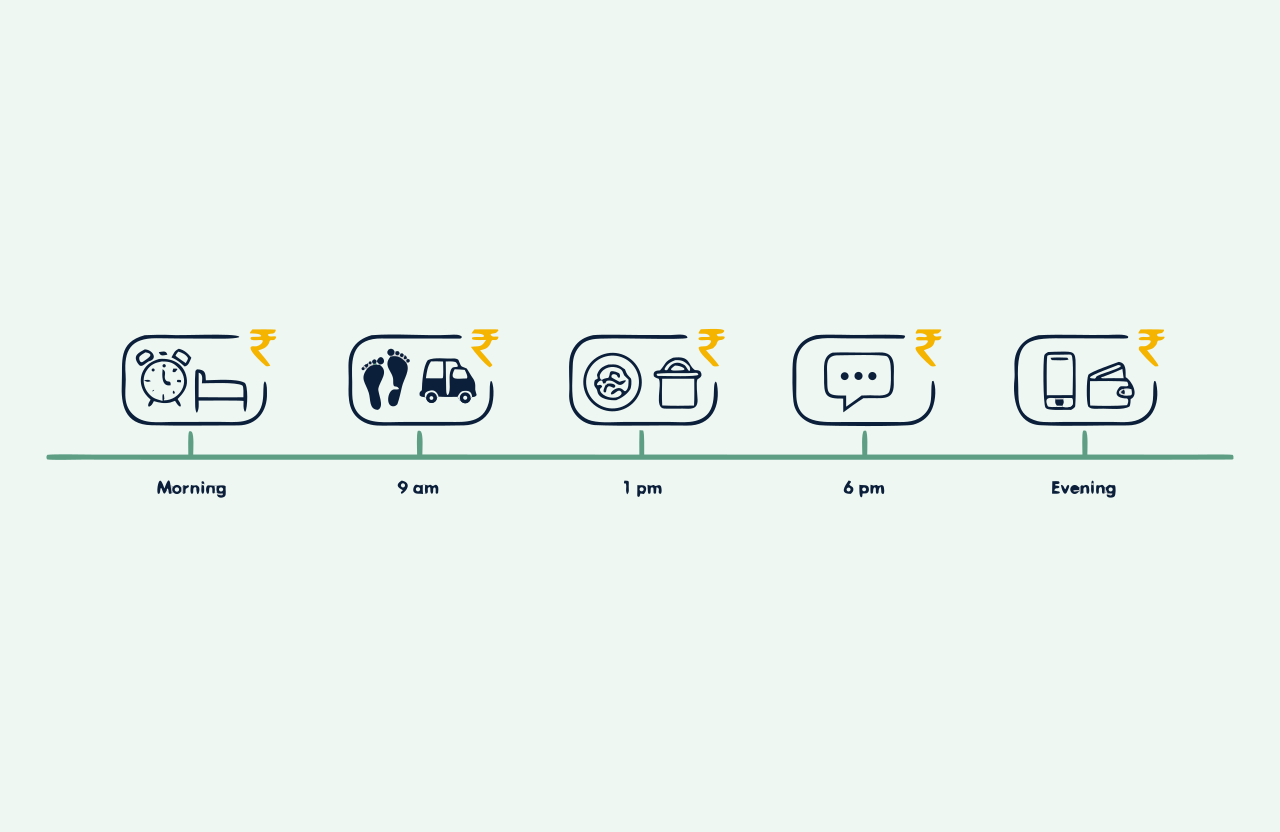
Rohan's alarm rang at 7:40. His lecture started at 8:15.
He shot out of bed, grabbed yesterday's shirt off the chair, and skipped brushing his hair properly. No time to think, just move.
In the kitchen, his mother had left idlis on the stove. He glanced at them, then at the clock, and grabbed two biscuits from the jar instead — faster. "Not a big deal," he told himself, stuffing his bag.
Outside the gate, he had a choice: walk to the bus stop or wave down an auto. His legs said walk. His watch said auto. He raised his hand, and one pulled up in ten seconds.
On the ride, his phone buzzed. Aditi, from his class: "Skipping first lecture, hanging near the canteen, come?" He typed back "on my way" before he'd even finished reading it properly.
He reached college, dropped his bag near the canteen bench, and let out a breath. Made it. Sort of.
Later that day, waiting for a friend, he found himself replaying the morning — mostly to laugh at how chaotic it was. Woke up late. Skipped breakfast. Took an auto. Said yes to Aditi without thinking twice.
Then a small, odd thought stopped him mid-scroll on his phone.
Not one part of that morning had felt like a "money decision." No bill, no bank app, no price tag flashing in his mind. And yet — the biscuits instead of the idlis at home, the auto instead of the free walk, the "on my way" that meant skipping a lecture and figuring out lunch some other way — every single one of those moments had a rupee sitting quietly inside it, waiting to be noticed.
He hadn't thought about money once that morning.
That didn't mean it wasn't there.
Rohan sat with that for a second, turning it over like a coin he'd just found in an old pocket — not sure yet what to do with it, but fairly sure it wasn't nothing.
2Learning Objectives
- Recognize that money is present in almost every life decision, even ones that don't look like 'money decisions' (e.g., walk vs auto, eat out vs cook).
- Distinguish between 'I wasn't thinking about money' and 'money wasn't involved' in a decision.
- Explain why ignoring money's presence is itself a choice with consequences, not a safe neutral default.
3Core Concept
Think about how many small choices you make before lunchtime. Waking up, deciding what to eat, how to get somewhere, whether to say yes to a friend's plan. None of these feel like "money decisions." There's no bill in front of you, no bank app open. So it's easy to assume money had nothing to do with any of it.
Here's the truth: money is quietly part of almost every one of those choices, whether you notice it or not. Walking or taking an auto, cooking or eating out, saying yes to a plan or skipping it — each one has a rupee sitting inside it. You just weren't looking for it.
This is where most people get confused. They mix up two very different things: "I wasn't thinking about money" and "money wasn't involved." These sound similar, but they are not the same. Not thinking about something is a gap in your attention. It says nothing about whether that thing was actually there. A fan can be spinning above your head while you're absorbed in a book — you not noticing it doesn't stop it from spinning.
Not thinking about money doesn't mean money wasn't there.
Financial awareness — simply noticing money's role in a decision, as opposed to actively managing or knowing about it — starts exactly at this gap. It's the moment you realize "I wasn't paying attention" is different from "there was nothing to pay attention to."
Now, here's the part that changes how you should act.
There's a second, sneakier belief that trips people up: that ignoring money is somehow safe. If you don't think about it, you can't get it wrong, right? But that's not how it works. Choosing not to notice money's role is still a choice — and like any choice, it has consequences. The auto still cost money whether you noticed the trade-off or not. Skipping breakfast for biscuits still meant spending on something small and convenient instead of what was already at home. Avoidance doesn't remove money from the equation; it just removes you from the decision-making.
So the real starting point of financial understanding isn't a formula, a budget, or an app. It's simpler and comes before all of that: noticing. Before you can manage money wisely, you first have to see where it already shows up in your ordinary day. That habit of noticing is what this unit is building.
4Visual Understanding
5Real-life Example
Later that morning, Rohan is standing outside his gate again, bag on his shoulder, already ten minutes behind. Two options sit in front of him: walk the fifteen minutes to the bus stop, or wave down an auto and get to class faster.
At first, it doesn't even feel like a decision worth pausing on. It feels like a timing problem — walk and risk being later, or auto and make it on time. His hand is already halfway up to flag one down.
Then he catches himself, mid-thought, the same way he did earlier that morning. He's not just choosing speed over time. He's choosing to spend money — money he was planning to save for the weekend — to buy himself those fifteen minutes back. That trade was sitting right there in the decision the whole time. It didn't announce itself as "a money choice." It just looked like being late or not.
Rohan still takes the auto. That's not the point. The point is that this time, he sees the rupee in the decision instead of walking past it without noticing — the same quiet presence money had all morning, except now he's actually looking at it.
Point: Even decisions that feel purely practical (timing, convenience, comfort) often have a quiet money dimension — noticing it is what separates awareness from autopilot.
6Common Mistakes
- Believing money only matters for big things — salary, bills, investments — not small daily choices. — Small decisions like walking versus taking an auto don't feel like 'finance,' so they seem to belong to a totally different category than money matters. Fix: Remind yourself that scale doesn't decide whether money is involved. A five-rupee choice and a five-thousand-rupee choice both count — size just changes how loud the decision feels, not whether money is present.
- Assuming that if you didn't consciously think about money in a decision, money wasn't really a factor. — It's natural to treat your own awareness as the full picture — if you didn't notice something, it feels like it didn't happen. Fix: Separate the two questions. Ask 'Did I notice money here?' and 'Was money actually here?' separately — they often have different answers, and the second one is the one that's true regardless of your attention.
- Treating avoidance of money as a safe, neutral way to live. — Thinking about money can feel stressful, so not thinking about it feels like protection rather than a decision with its own outcome. Fix: Notice that ignoring money still produces results — the auto still costs what it costs. Treat 'not deciding' as a decision too, one that deserves the same honest look as any other.
7Key Takeaways
- Money is already quietly part of almost every choice you make — the only real choice is whether you notice it or not.
- 'I wasn't thinking about money' and 'money wasn't involved' are two different things — not noticing is a gap in awareness, not proof of absence.
- Ignoring money's presence is not a neutral, safe default — it's an active choice, and it has consequences like any other.
- Noticing comes before managing — you can't budget, save, or plan for something you haven't first learned to see.
- Even decisions that feel purely practical, like timing or convenience, often have a quiet money dimension worth pausing to notice.
8Quiz
Q1. According to this unit, which statement is true about everyday choices like walking versus taking an auto, or cooking versus eating out?
- Money is quietly part of almost every one of these choices, even if it doesn't feel like a 'money decision'
- Money is only involved if you specifically think about price before deciding
- These small choices have nothing to do with money since no bill or bank app is involved
- Money only matters once the choice involves more than a few hundred rupees Answer: Money is quietly part of almost every one of these choices, even if it doesn't feel like a 'money decision' — Money shows up in nearly every decision, big or small — the size or feel of the choice doesn't decide whether money is present.
Q2. Priya says, 'I didn't think about money when I agreed to order food instead of cooking, so money wasn't really part of that decision.' What's the flaw in her reasoning?
- She is confusing 'I didn't notice it' with 'it wasn't there' — her awareness doesn't decide whether money was actually involved
- There is no flaw — if you don't consciously think about money, it truly isn't a factor
- She is right, but only because ordering food is a small decision
- She should have calculated the exact cost before making any conclusion Answer: She is confusing 'I didn't notice it' with 'it wasn't there' — her awareness doesn't decide whether money was actually involved — Not noticing money in a decision is a gap in attention, not proof that money wasn't part of it. The rupee cost of ordering food was there whether Priya thought about it or not.
Q3. True or False: Choosing to never think about money is a safe, neutral way to avoid financial mistakes. Answer: False — Ignoring money is still an active choice, and it has consequences just like any other choice — there's no truly neutral or risk-free option when money is quietly involved anyway.
Q4. Kavya is running late and grabs a packet of chips instead of the lunch already packed at home, telling herself, 'This isn't really a money thing, I'm just hungry and in a hurry.' Using what you learned in this unit, what's the wiser way for Kavya to look at this moment?
- Recognize that even though it feels like a hunger-and-timing decision, there's a quiet money angle worth noticing — she's spending on the chips instead of using what's already at home
- Ignore the moment completely, since it's too minor to matter for financial awareness
- Wait until she has a formal budget before considering whether small purchases involve money
- Conclude that since she didn't plan to spend money, this choice truly had nothing to do with money Answer: Recognize that even though it feels like a hunger-and-timing decision, there's a quiet money angle worth noticing — she's spending on the chips instead of using what's already at home — Like Rohan's morning, Kavya's choice feels practical on the surface, but there's a quiet rupee decision inside it. Noticing that — without needing to act on it yet — is exactly the awareness this unit is building.
Q5. Someone says: "I don't really think about money day-to-day, I just live my life normally." Does not thinking about money mean money isn't involved in their decisions? Reveal: Weak: yes, if they're not thinking about it, it's not a money decision. Strong: money is present in almost every choice (walk vs. auto, cook vs. order) whether or not it's consciously noticed — not noticing it is itself a choice with consequences, not proof it's absent.
9Curiosity Bridge
Somewhere between waking up and reaching class, Rohan's day was already full of rupees he never saw — what else might be sitting quietly in your own ordinary choices, waiting for you to simply look?
This week, try: Pause for five seconds and ask yourself, 'Was money quietly part of this choice?' — then simply notice the answer, without needing to act on it. (Say the question out loud to yourself once today — 'Was money part of this?' — right at the moment you catch yourself making a small everyday choice.)
Think about yesterday — was there a moment where money quietly shaped what you chose to do, even if you didn't think of it as a 'money decision' at the time? Yes/No
(Binary Yes/No choice with an optional one-line free-text note describing the moment)
“It is remarkable how much long-term advantage people like us have gotten by trying to be consistently not stupid, instead of trying to be very intelligent.”